Leica M11-D: On Privilege, Presence, and Why I Can't Defend This Purchase
Date
February 19, 2026
Tags

A camera I can't justify by any rational metric. A decision I'd make again in a heartbeat. On spending instead of investing, screens that aren't there, and what it means to commit to slowing down.
The Unjustifiable
I cannot defend this purchase.
Not by specs. Not by logic. Not by any metric a reasonable person would use to evaluate a camera. For the same money, I could have bought a Hasselblad X2D with resolution to spare, or a Sony A7CR that would autofocus on a sparrow mid-flight from across a football field. I could have invested the whole sum and watched numbers multiply into other numbers, compounding quietly toward some distant future self who might appreciate the foresight.
Instead, I bought a Leica M11-D and a Voigtländer Nokton 50mm f/1.5.
The body has no screen. The lens has no autofocus. The combination costs more than my entire previous camera kit combined. By every standard that camera reviewers care about, I made the wrong choice.
I'd make it again tomorrow.
The Elephant, Briefly
Let me address what needs addressing: I didn't earn this money through freelance gigs or careful saving. It came as a gift, a significant sum given for reasons that are mine to know and complicated to explain. Accepting it felt like a weight. Using it felt like a statement.
I considered investing all of it. The rational move. Let the numbers grow. Watch the portfolio compound. Add another zero to a spreadsheet I'd check too often.
But here's what I kept returning to: even if it worked out perfectly, it would just be another cold number I successfully optimized. Another metric in a life already too full of them. And I would have gotten this camera somewhere down the line eventually. Maybe at thirty. Maybe at fifty. I know someone who bought his first Leica at fifty, and now he struggles with the rangefinder because his eyes aren't what they were.
My eyes are sharp. My hands are steady. And I've spent enough time in hospital rooms to know that "later" is a bet, not a guarantee. The decades I'll spend with this camera are decades I'd lose waiting for a "better time" that doesn't exist.
The weight of receiving this gift hasn't disappeared. But maybe carrying weight is the point. Maybe it's supposed to make you think harder about what you do with it.
Milan, January 22nd
The day came in two surprises.
The first: a Leica store near the Duomo, the kind of shop where the staff could reasonably assume a teenager in a winter jacket isn't there to buy. The clerk who approached me didn't make that assumption. His English was excellent, his patience inexhaustible. An hour earlier I'd been eating a focaccia sandwich with no plans beyond lunch. Now I was walking out with an M11-D I hadn't expected to own until my thirties.
The second: a camera store near our Airbnb, where I'd gone hunting for a black Nokton for a black-on-black look. Only silver was in stock. I hesitated. Then I mounted it on the body and watched the silver barrel align with the chrome lens mount, a symmetry I couldn't have designed. The color I didn't choose became the color I would have chosen, had I known better.
We stuffed both boxes into my mom's bright yellow Snoopy bag, paranoid about theft, looking nothing like people who'd just spent what we'd spent. My sister had watched me deliberate, assuming it was a few-thousand-NTD decision. The number was in euros.
The Logical Terminal
In my X-Pro1 piece, I wrote about shackles I learned to dance in. The M11-D is where that dance was always heading.
The X-Pro1's hybrid viewfinder was a step toward something it couldn't fully become. The optical finder showed you the world, but focusing still required switching to the digital overlay, peaking focus, hoping you got it right. The OVF was more or less a gimmick for framing—beautiful, but functionally incomplete.
The M11-D completes the circuit. A true coupled rangefinder means the optical viewfinder is the focusing system. No switching. No peaking. A split image in the center of the frame that snaps into alignment when you've nailed it. The experience is almost fully mechanical on a digital body.
And then there's the missing screen.
Leica removed the rear LCD entirely, replacing it with an ISO dial. No chimping. No checking. No anxiety loop of shoot-review-adjust-repeat. You take the photograph and you just move on. Sometimes I don't see my images for three days. When I finally do, it's like unwrapping small time capsules, moments I'd half-forgotten, returned to me with the strange clarity of distance.
Someone once asked me why I didn't just buy the M11 and turn the screen off. The answer is that I know myself. If the screen exists, I'll use it. Removing the option removes the temptation. The M11-D isn't a camera with a screen disabled; it's a camera designed around the screen's absence. The difference matters.
Learning to Trust
The first few days were, put mildly, humbling.
Without a screen to verify settings, I had to trust. Trust the aperture ring. Trust the rangefinder patch. Trust my own eyes. The camera forces you to know your fundamentals: that f/8 gives you hyperfocal depth, that 1/focal length is your handheld floor, that the labeled distances on the lens barrel aren't decorations.
I used to only change settings when I couldn't get the shot I wanted. Now I can't see the shot at all. So I stop needing to change the settings. The logic sounds circular until you live it.
After wearing my OK lenses consistently (a habit I'd been lazy about), the rangefinder became far more forgiving than I'd feared. By day four, focusing felt like second nature. By the end of the trip, I'd stopped thinking about it entirely.
There's a shot from Rome I almost deleted mentally the moment I took it. A man with a red umbrella walking down the street at night. I was walking, panicking, sure I'd blown it at f/1.5 and 1/4 second, everything wrong. When I finally saw the image days later, the motion blur had turned it into something like a panning shot. Not quite intentional. Not quite accidental. Better than both.
That's the thing about removing the feedback loop. You stop trying to get the perfect shot. You start trying to be present for the shot. The image becomes a byproduct of attention, not a target of optimization.
What Presence Actually Looks Like
Rome. February 4th. A sudden thunderstorm hits while we're at the market.
My pants are drenched; they weren't waterproof. My socks are slightly soaked inside shoes that were supposed to be waterproof. Plans canceled. The sensible thing would be to rush back to the apartment, protect the camera, wait it out.
Instead, I walk. And keep walking. Through rain I'd only ever experienced in summer Taipei afternoons, legs cold, absurdly expensive German engineering hanging from my neck. The shutter sounds like a small commitment each time I press it. I have no idea if the exposures are right. I have no way to check.
Legs cold, plans canceled, so alive.
This is what I couldn't have explained before the trip: the camera didn't make these moments happen. But it changed how I showed up for them. When you can't review, you can't retreat into the screen. You stay in the scene. You trust and move on.
A few days earlier, our rental car got stuck in the snow in the Dolomites. Cars backing up in both directions. My family stressed, the situation escalating. Then five Germans appeared and simply... helped.
Pushed us out. Asked for nothing. The host's son drove us to safety down roads we couldn't have navigated alone.
I photographed none of it. My hands were busy. But the camera had trained me to notice, to actually see the kindness instead of immediately reaching for my phone to document it. Sometimes presence means the camera stays down. The practice matters more than the frames.
On our last morning, my sister and I left the apartment at 3:30 a.m. for a final walk through Rome. Past the empty fountain. Past the Pantheon with no crowds. Past the Colosseum with only mice around. 6.5 kilometers to say goodbye to a city in the only way that felt right.
A friend once told me that for trips that matter, he doesn't bring a camera at all. If presence is the goal, why carry a device designed to interrupt it? And isn't removing the screen its own performance—paying premium to signal you're above the feedback loop?
I thought about that as we walked. The M11-D came with me. The shutter clicked occasionally. But mostly I just walked, looked, and let the city exist without trying to capture it. Maybe that's the only answer I have. The line between practice and posturing isn't always visible, even from inside.
This, I think, is what the camera was actually for. Not the resolution. Not the rangefinder. The permission to be slower than the world asks you to be.
What the Sensor Sees
Technical specifications still matter, of course. Just not in the ways review sites measure them.
The Voigtländer renders contrast like it has something to prove. There's a shot from Seceda where I could feel the sharpness before even zooming in—60 megapixels resolving a mountain ridge with detail that startled me when I finally opened the file, days later.
The camera has quirks. Auto white balance gets moody. The metering requires workarounds. I've learned to shoot DNG alongside JPEG for the difficult cases and trust the latitude when things go sideways.
But most of my shots are still soft. Still often off-focus. Still one keeper per day if I'm lucky.
Honestly? That's the point.
The Commitment
There's an irony I can't escape: I spend my research hours optimizing language models for safety, building guardrails, constructing taxonomies of harm. I make AI systems better at constraints. Then I pick up a camera that refuses to be optimized at all.
But maybe that's not contradiction. Maybe that's balance.
The work I do requires systematic thinking—taxonomies, benchmarks, measurable improvement. That mindset is valuable. It's also corrosive if it spreads to everything. Some parts of life should resist the optimization instinct. Some tools should force you to accept what happens instead of iterating toward perfection.
Here's what I keep returning to, the thing that made me pull the trigger despite every rational objection:
I was not sold on the Leica because of the build, the heritage, or the image quality. Those matter, but they're not the reason.
I was sold on a lifelong commitment to being a person who slows down for the present when the world—and sometimes I—fixate on chasing the horizon.
In Italy, I watched people live in ways I'd forgotten were possible. They didn't look at their phones over meals. They jogged in freezing weather because bodies were meant to move. Beauty saturated the streets of Milan so thoroughly that I saw maybe two badly designed posters the entire trip. And I kept thinking: this is what it looks like to live beyond only being alive.
The camera became part of that lesson. Not a device for capturing moments, but a practice for deserving them.
The Question I Can't Answer
Will fifty-year-old me think this was the right call?
I don't know. I hope I'm still picking up this body and this lens 32 years from now, hands a little less steady, eyes a little less sharp, still showing up for moments I can't predict.
I hope the weight of this gift—complicated, appreciated, impossible to fully explain—has become something I carry easily by then. Something that taught me more than any spreadsheet could.
I hope I remember the thunderstorm in Rome. The Germans pushing our car out of snow. The 3:30 a.m. walk past monuments older than my country. The moments the camera helped me notice and the moments it taught me to put it down.
I cannot defend this purchase by any metric that matters to people who measure cameras by specifications.
But I'm not sure I was ever trying to convince them.
The best camera isn't the one with the best specs. Sometimes it's the one that makes a statement about who you're trying to become. Sometimes the statement costs way more than it should. Sometimes you make it anyway, knowing full well you can't justify it, knowing you'd do it again, knowing the only person you really need to convince is the one holding the camera.
The weight hasn't gotten lighter. I don't think it was supposed to.
But somewhere between Milan and Rome, between the thunderstorm and the 3:30 a.m. walk, I stopped noticing I was carrying it.
The Collections
I have written at length about the internal process of shooting without a screen. If you wish to see the external results, what the sensor actually captured during these weeks in Italy, I have curated the images into three collections.
- If on a winter's night a traveler...: The Dolomites, the snow, and the silence of the mountains.
- Interlude: Street photography and fleeting moments in Milan, Florence, and Rome.
- Marginalia: The quiet accidents of light found in the smaller towns.
Acknowledgments
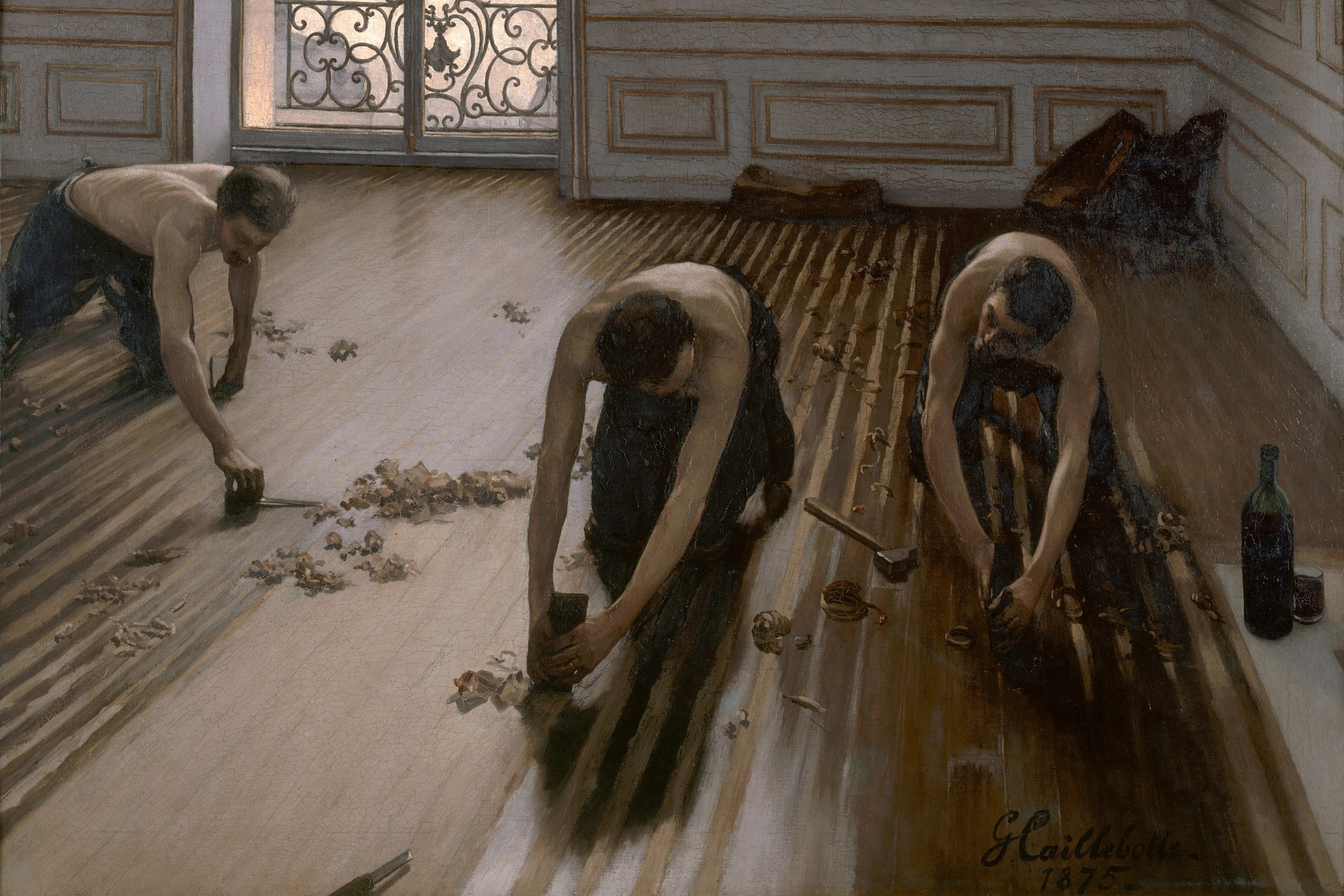
- Title image: Les raboteurs de parquet by Gustave Caillebotte, Public Domain, Link. Like the workers in the painting, this camera asks you to stay absorbed in the craft, not just efficient in the output.
- Special thanks to Justin and Charlie for their feedback on early drafts.