Being a Stranger, in the Name of Love: On Aftersun and Paris, Texas
Date
December 22, 2025
Tags

Two films about parenthood, distance, and the unbearable weight of being seen. A synthesis.
The Films That Won't Leave
Some films end when the credits roll. Others move in and refuse to pay rent.
Aftersun and Paris, Texas are separated by nearly four decades, different continents, different directors, different everything. And yet, watching them months apart, I couldn't shake the feeling that they were having a conversation. Not about the same events, but about the same wound.
Both films ask a question I've been sitting with for a while now: what does it mean to love someone you can't fully reach? What happens when presence becomes its own kind of distance?
The Shape of Absence
In Paris, Texas, Travis walks out of the desert after four years of self-imposed exile. He's been running from the wreckage of his marriage, from his son Hunter, from the violence of his own love. When he finally reunites with Jane in that peep show booth, speaking to her through a one-way mirror, he does the only thing he knows how to do: he tells her the truth, then disappears again.
He doesn't stay. He can't stay. The film ends with Travis watching from a distance as Jane and Hunter embrace, then driving off into another kind of desert. He loved them enough to bring them together. He loved them enough to leave.
In Aftersun, the distance is different but equally devastating. Sophie is 11, on vacation with her father Calum, and she doesn't understand what she's seeing. She can't. The camera catches glimpses of Calum staring into nothing, crying alone on a balcony, moving through the days with a heaviness she won't recognize until decades later. The film is constructed as memory, as home video footage revisited and re-examined by an adult Sophie who now understands what her 11-year-old self couldn't.
The Mirror and the Camcorder
Both films weaponize barriers. In Paris, Texas, it's the one-way mirror in the peep show booth. Travis can see Jane. Jane cannot see Travis. He speaks into a phone, narrating their shared history, and she slowly realizes who's on the other end. The glass makes confession possible. Without it, he wouldn't have been able to speak at all.
In Aftersun, the barrier is time itself. Sophie watches her father through the mediation of a camcorder, through the distortion of memory, through the impossible gap between child-perception and adult understanding. She can see him now. But she's seeing a recording. She's seeing absence wearing her father's face.
What strikes me is that both barriers enable a kind of intimacy that direct contact couldn't. Travis needed to be invisible to tell the truth. Sophie needed thirty years to see what was always there. Perhaps the clearest view comes through glass.
"Sometimes, to love someone, you gotta be a stranger"
That line from Blade Runner 2049 has been rattling around my head since I first heard it. Deckard says it to K, explaining why he left his daughter, why he stayed away for decades. It's a brutal kind of logic. Love as distance, protection as abandonment.
Travis embodies this literally. He tears himself out of his family's life because he believes his presence is poison. The fire that nearly killed Jane, the jealousy that consumed him, the wreckage of who he became. He looks at Hunter and sees a boy better off without him. So he becomes a stranger. Deliberately and permanently.
Calum's version is more ambiguous, more tragic. We never get full confirmation of what happens after that vacation. Charlotte Wells leaves it deliberately unclear. But the structure of the film, Sophie desperately rewatching footage, trying to find her father in the gaps between frames, suggests he didn't stay. Whether by choice or by something darker, he became a stranger too.
The difference is intention. Travis chooses to leave. Calum, perhaps, couldn't choose to stay.
What the Children See
Hunter remembers Travis from photographs. Sophie remembers Calum from MiniDV tapes. Both children grow up reconstructing fathers from fragments, trying to understand men who couldn't explain themselves.
In one pivotal scene of Aftersun, Sophie asks Calum what he thought he'd be doing at her age. His answer reveals the void where his future should be:
Calum: I can't see myself at 40, to be honest. Surprised I made it to 30.
The question breaks something in him, and the camera lingers on his face long enough for us to see it. Sophie, 11, doesn't notice. Sophie, 40, watching the footage, notices everything.
Hunter, however, doesn't need a camera to see what is true. Even in Travis's absence, he maintains a connection that defies logic.
Hunter: I never felt like you were dead. I could always feel you walking around and talking - some place.
Hunter, similarly, doesn't understand why his father left or why he came back. He just knows that Travis is here now, that they're walking together, that something is being repaired even if he can't name it. The understanding will come later, or maybe it won't. Maybe some distances never close.
The Weight of Being Seen
Here's what haunts me most about both films: neither father can bear to be truly seen.
Travis hides behind a one-way mirror. He narrates his failures in third person, as if telling a story about someone else. When Jane finally recognizes him, he's already planning his exit. The moment of connection is also the moment of departure.
Calum hides behind the performance of being a good dad. He plans activities, he dances with Sophie at the resort, he pretends everything is fine. But the cracks show.
The camcorder catches what his face tries to conceal. And when Sophie, as an adult, watches those recordings, she sees a man drowning in the very sea she once swam in with joy without even noticing.
To be seen is to be known. To be known is to be vulnerable. And for men carrying the weight these two carry, vulnerability feels like death.
Why These Films Stay
Aftersun and Paris, Texas both reject and validate this logic simultaneously. They show us the cost of absence. Sophie, grown, still searching for her father in footage that will never yield what she needs. Hunter, reunited with his mother but losing his father again. The children are shaped by the distances their fathers created.
And yet, Travis's departure allows Jane and Hunter to heal without him. Calum's struggle, hidden as it was, gave Sophie a vacation full of genuine moments, real connection, memories worth revisiting. The fathers were drowning, but they kept their children above water as long as they could.
Is that enough? Is love measured by what we give or what we spare others from?
Maybe that's the wrong question. Maybe love was never a shape we got to choose. Travis chose the desert. Calum chose the balcony. Sophie chose the rewind button. And we, the audience, choose to press play again and again, knowing the ending won't change, still hoping that this time, the man on the other side of the glass will turn around.
They won't. But we'll keep watching anyway.
Acknowledgments
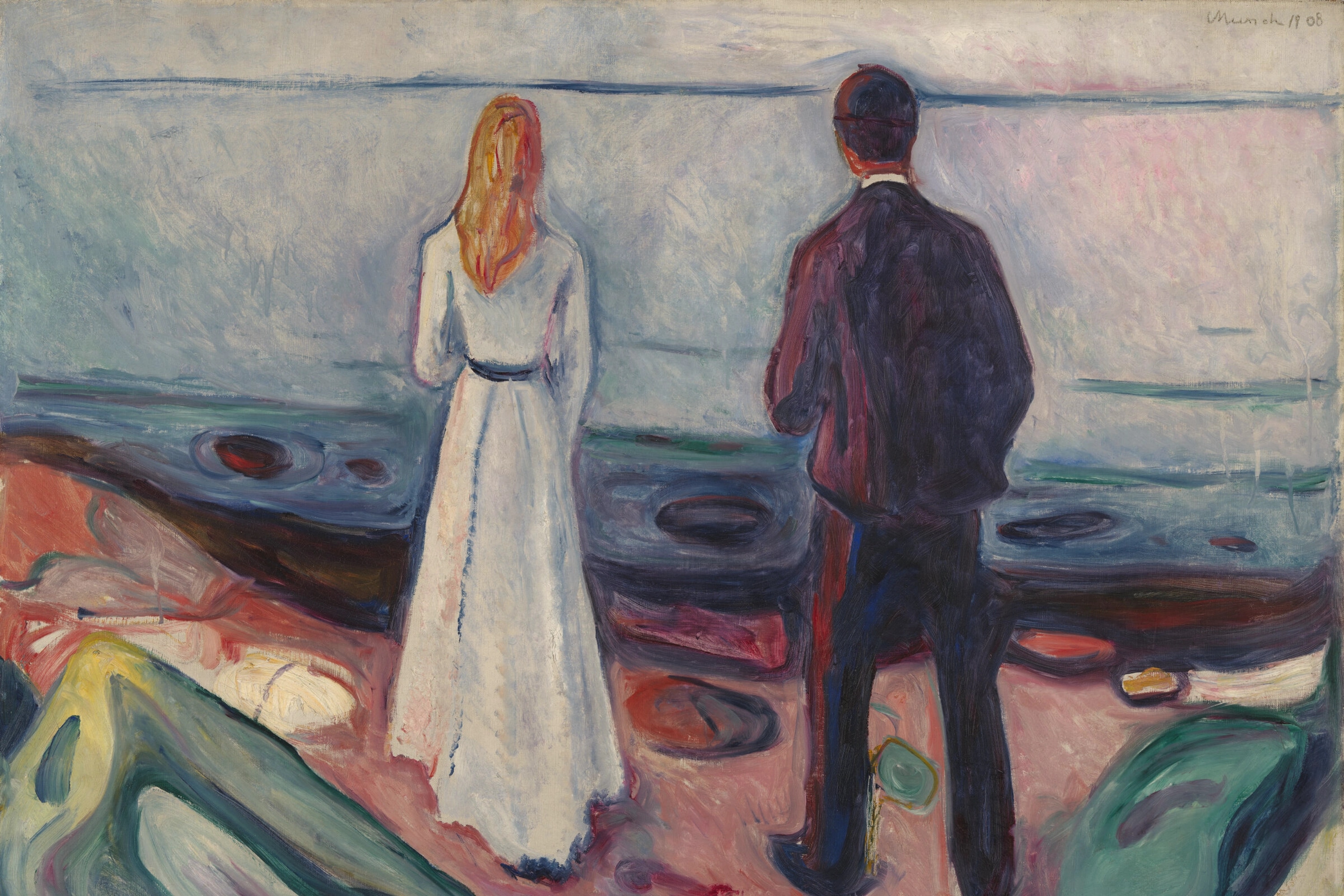
- Title image: Two Human Beings (The Lonely Ones) by Edvard Munch, Public Domain, Link
- Still images from FILMGRAB, courtesy of the respective filmmakers
- Aftersun (2022), directed by Charlotte Wells
- Paris, Texas (1984), directed by Wim Wenders
- Quote from Blade Runner 2049 (2017), directed by Denis Villeneuve