All C: Of Fake Autobiographies and Borrowed Answers
Date
September 19, 2026
Tags

In sixth grade I wrote my autobiography, birth to death. Six years later I'm standing on the campus it promised, grading it. On thirty subs, a poison character, and everything the kid got right without trying.
Thirty Subs
Nobody hires a fresh graduate. My classmates and I spent months looking. A few gave up and moved back in with their parents, permanently. I wanted a big company. I got a Subway.
The work was easy, honestly. You make subs. Occasionally a salad, occasionally you tong a cookie into a bag. The customers were the problem. One man asked for double vegetables. If you have ever tried to close a sub holding the regular amount of vegetables, a task that already drains your will to live, you understand what he was asking. I was about to clock out, so I handed his order to the next shift (let us observe three seconds of silence for him).
Another man walked in and ordered thirty subs. And the point is, he had no reservation. No reservation!! So I and one other employee, equally pitiable, stood there and made thirty subs.
I stayed two years, then left to find a real job.
I have never worked at a Subway. I wrote all of that in sixth grade, in a classroom, for the gifted program, and the Subway isn't even mine. It belongs to TheOdd1sOut, a YouTuber who animates his fast-food jobs, whose videos I watched on an iPad in quantities that also account for my English. It's the kind of English that drives teachers up the wall, because my only grammar rule is "it sounds right," and it usually is. I've confessed on this blog to stealing a layout. Apparently I started early.
The Assignment
The genre has a name in Chinese that translates, roughly, to "fake autobiography." Sixth grade, gifted program: write your life, birth to death. Not what do you want to be. The whole thing, with a deadline.
Conventions formed within about a week. Everyone is a comic narrator. Everyone heckles themselves in parentheses. Everyone gets a career, a war, and a death. I've wondered why a room of sixth graders went so cheerfully to their graves, and the only answer I have is the one I'd have given then: death was much easier to write than adulthood.
I know it was written in one room because the documents share jokes. I have three of them now, mine and two friends'. "Let us observe three seconds of silence" appears in all three: for my Subway customer, for one friend's schoolmates who never got a graduation trip, for the other's textbooks, thrown across a room in exam season. Nobody knows who had it first. All three of us schedule a third world war. All three of us graduate from the best university in the country and go directly into food service. We read each other's drafts as we went, out of curiosity or, in my less talented case, for inspiration. Sixth-grade prose has a commons.
Mine resurfaced recently. About half our old cohort took a three-day trip together, got nostalgic, and went looking for photos, so our teacher shared the old class Google Drive. We found the photos. We also found Gantt charts, which we had apparently been making at ten, and a folder of finished lives.
The Real Half
Half the document is checkable, because half of it had already happened.
Before kindergarten, he rides a bicycle into a large rock, flips, and wakes up in a hospital, where his mother hands him a popsicle and tells him he has seven stitches. "After this, I didn't start hating bicycles. I actually started liking them."
Kindergarten, in full: "toilet, eat, class, eat, eat, eat, sleep."
First grade, first Chinese quiz: 37. His mother had things to say.
Same year, a quiz asks him to write "drink tea." He adds a stroke nobody asked for.
茶 荼
The first one is tea. The teacher calls him to her desk: "荼 is a poison. Don't write it carelessly." He never forgot the character again.
Second grade: he hates Tuesdays. Full day, mandatory nap.
One weekend his mother drives him somewhere without explanation, and it turns out to be the gifted-program exam. "I don't want to take a test!! I don't want to take a test!" Her: "Just go try." Then she hands him a banana. He writes, in parentheses, that he doesn't know why he still remembers the banana. I don't either. I still do.
He passes, three rounds, and transfers to the school that has a gifted program (and air conditioning) from the school that has no gifted program (and no air conditioning).
Third grade, the program holds an auction with play money, except the lots are things like friendship and health. One classmate spends everything he has on friendship. Our narrator spends two thousand on food.
All C
The future starts in middle school, and almost the first thing he reports from it is this:
Once I got to middle school, Chinese got harder, but however hard it got, it wasn't as hard as English, because English exams have an essay, so even if I knew everything there was no way to finish. So one minute before the end of every exam, I would fill in all the remaining blanks on the answer sheet with C. I don't know why I always chose C, but I think it's because my sister told me a lot of the answers are C?
He has been in the future for one paragraph and he is already out of time.
I laughed. Then I read the rest of his life, and it's the same minute all the way down.
High school: the entrance exam, then the good public one, because that is what comes after the entrance exam. University: the Joint College Entrance Exam, a test abolished six years before he was born, which he can only have gotten from a grown-up. Then Electrical Engineering at National Taiwan University. He was building LEGO robots at the time and figured EE was where robots came from, so this is the one bubble he believed he was actually answering. Still wrong.
First job: Subway. Source: YouTube.
The war: 2064, the United Nations shelled by a plasma satellite cannon. Source: it was cool, and the boy across the aisle had one too. His arrives eight years after mine, with far better weapons.
The career: a robot company, programmer to CEO. Here is all of it: "I kept getting promoted and kept working, for a quarter of a century." The card game he designed for a third-grade welcome party gets a full paragraph, rules included. Twenty-five years of work gets a clause.
And after one friend, written into the seat beside him at university, the future is empty. No parents. No sister, except as the authority on C. When a car hits him on his way to the office, the only other person in the scene is a doctor. The real half is crowded: teachers, the kid he met over a Pokémon argument on his first day at the new school, the boy at the auction. He could only people the past.
Here's what the forecast looks like when you grade it. Almost. I had two more to read first.
The Other Two
The friend with the better war sends himself through Taipei's most famous boys' high school and into Public Health at NTU. His World War III runs thirteen years and features tachyon guns and antimatter grenades, against which my plasma cannon looks like a school project. At eighty-six he goes back to his childhood bedroom, notices the old stain still on the mattress, and lies down.
The other friend is the one who spent everything on friendship. In sixth grade he wrote that he got into "National Taiwan University, Computer Science (honestly I surprised even myself)."
He is now at National Taiwan University, in Computer Science. Same intake as me.
They wrote each other in, too. In the friendship friend's document he gets lost on campus for an hour and is rescued by a third classmate whose name he pretends to half-remember. He also mentions that a good friend of his went on a night ride up a mountain sophomore year. Open that friend's document: sophomore year, night ride, told from the scooter. They had cast each other. So had I. The one friend in my future, the boy beside me in the EE exams, went to a different high school in real life, and we drifted the ordinary way.
All three documents, I noticed, agree on exactly one thing about the place: it is enormous.
Three boys, three fictional NTU departments. Six years later all three of us are on that campus. One named his department exactly. None of us got here the way we said we would, and my own door into the building was one the fiction didn't know existed.
Week Two
So, week two. The grading.
What he got right, quoted whole: the best part of NTU is that there's so much to eat, because the place is huge, and there's good food all over campus, and streets to eat and wander through all around it, "and because there are so many trees the campus stays cool, so even in summer it never gets that hot."
Correct. All of it. It took me a few days of walking around to work out why.
Saturdays. My dad, the bike, the long road between the big trees, years of it. This is the boy who took seven stitches and liked cycling more afterward. He wasn't forecasting the campus. He was remembering it forward. Same with the food: he spent his auction money on it, and when the gifted program sent us to map Tamsui for a scavenger hunt, his group drew the food category and he considered this the luckiest thing that had ever happened to him. Ask him about departments and he copies. Ask him what's for lunch and he's an authority.
What he got wrong is everything with a letterhead. The exams. The high school. The department. The professor who fails you on the spot for an audible yawn; the real ones have been, so far, unexpectedly relaxed. The plan to pretend to take notes while gaming; I've turned out to be the one who actually wants to be in the room, which would have disgusted him. Nobody has handed me a computer to take apart. He was looking forward to that, though he notes you get yelled at if it doesn't go back together.
Then there's the one he was surest of. In the fictional high school he declares himself "completely clueless" at Chinese, good only at science, math, computers, and English. He picks EE for a stated reason: in EE, it doesn't matter if you're terrible at the humanities. This is the boy with the 37, and he is making the announcement in some four thousand characters of comic timing, with callbacks.
The class I ranked first this semester is Chinese literature. It runs three hours and felt short. In week two I made an observation about choosing slower mediums, and got complimented for it.
The bubble he was most certain about is the one he had exactly backwards.
The cast, for the record. The boy who spent all his money on friendship is at the next bench in my physics group. The boy with the better war is in my Chinese class. In week one, twelve strangers found each other for lunch. The fictional life had one friend and then nobody. The real one filled a table before the first quiz.
I'll Tell You Later
The document opens with a date and a galaxy far, far away, where a new Jedi is born. "Uh, wait, no." Where an ordinary person named Chang Chi-Wei is born. "Actually, he's no ordinary person! He's… I'll tell you later."
He never does. I checked. A career, a war, a car, and the sentence is still open on the last page. My guess is the deadline got him, the way the bell gets him in every English exam he ever imagined. One minute left, one blank, and for once he didn't fill it in.
I've thought about paying it for him. I have candidates. But every one of them is an answer I got from somewhere, and I've read where that goes. Maybe it was the only honest blank in the document: the one question he couldn't copy, so he left it for later, and later turned out to be me, eating lunch under trees he already knew.
The file is still in the shared drive, one folder over from the Gantt chart. The Gantt chart, for the record, is complete.
My first required course this semester is programming. The language is C.
Acknowledgments
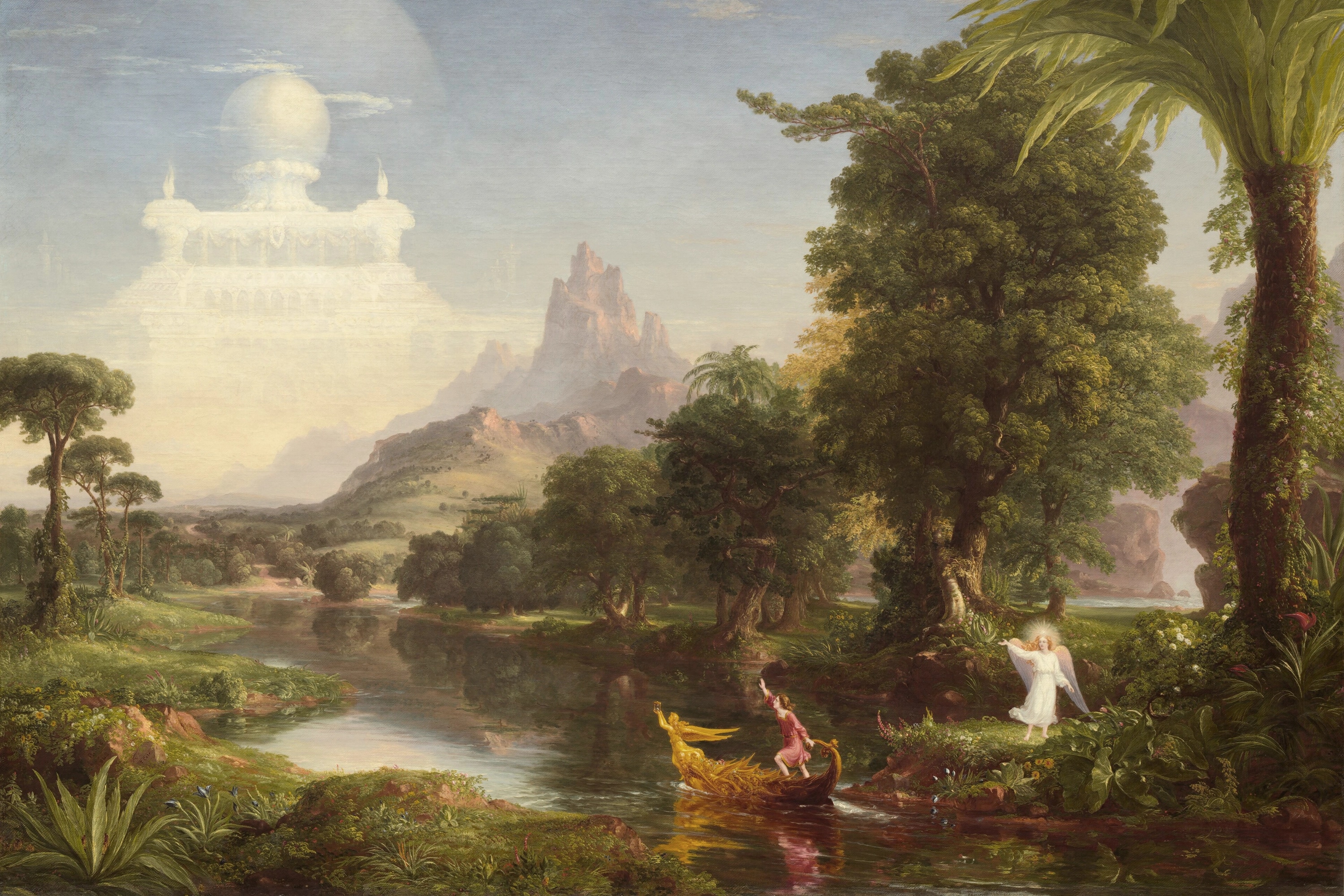
- Title image: The Voyage of Life: Youth by Thomas Cole, National Gallery of Art, Public Domain, Link. Cole's youth stands up in the boat to point at a palace in the clouds, and doesn't notice the river bending away to the right. Every bubble with a letterhead on it is that gesture.