The Myth of Sisyphus: On Absurdity, Struggle, and Why Reading Still Matters
Date
December 13, 2025
Tags

A retrospective review of Camus' philosophical essay after a re-read, and why the act of reading itself is an act of rebellion.
One Must Imagine Sisyphus Happy
There's a certain irony in choosing Camus for my first real blog post. A multi-year commitment to writing is, after all, just another boulder to push. But perhaps that's precisely the point.
I first encountered The Myth of Sisyphus years ago and, initially, struggled with it. The words are deceptively simple. There's no dense academic jargon, no labyrinthine sentence structures. And yet, something refused to click. I read it, summarized it, cited it endlessly in my Chinese GSAT essays—but I hadn't felt it.
This re-read was different.
The Absurd, Revisited
Camus opens with what he calls "the one truly serious philosophical problem": suicide. It's a jarring hook, but he's not interested in morbidity. He's interested in reason. If life is meaningless, why bother? His answer is deceptively defiant: because it's meaningless.
The absurd arises from the collision between our desire for clarity and the universe's indifferent silence. Camus doesn't ask us to resolve this tension. He asks us to live within it—fully aware, fully awake, refusing the comforting escapes of religion, philosophy, or denial.
Sisyphus, condemned to roll his boulder up a hill for eternity only to watch it roll back down, becomes the absurd hero. Not because he succeeds, but because he persists. And in that persistence, he finds something.
Why This Book, Why Now
I'll be honest: I've probably overused Sisyphus. He's appeared in more of my essays than I'd care to admit. But revisiting the source reminded me why I kept returning to him in the first place.
We live in an era of summaries. TL;DRs. Five-minute explainers. I'm guilty of it too, skimming abstracts, watching video essays at 2x speed, treating knowledge as something to be extracted rather than experienced. But Camus resists extraction. His prose demands presence. You can summarize the thesis in a sentence: embrace the absurd. But the sentence means nothing without the journey.
That's the quiet rebellion of reading: it forces you to slow down. To sit with discomfort. To let ideas marinate rather than evaporate.
The Struggle Itself
"The struggle itself toward the heights is enough to fill a man's heart."
This blog is my boulder. Research, photography, the next few years of applications and uncertainty—all boulders. They'll roll back down. They always do. But Camus taught me that the rolling back isn't the tragedy. The tragedy is stopping.
So here's to the climb.
Acknowledgments
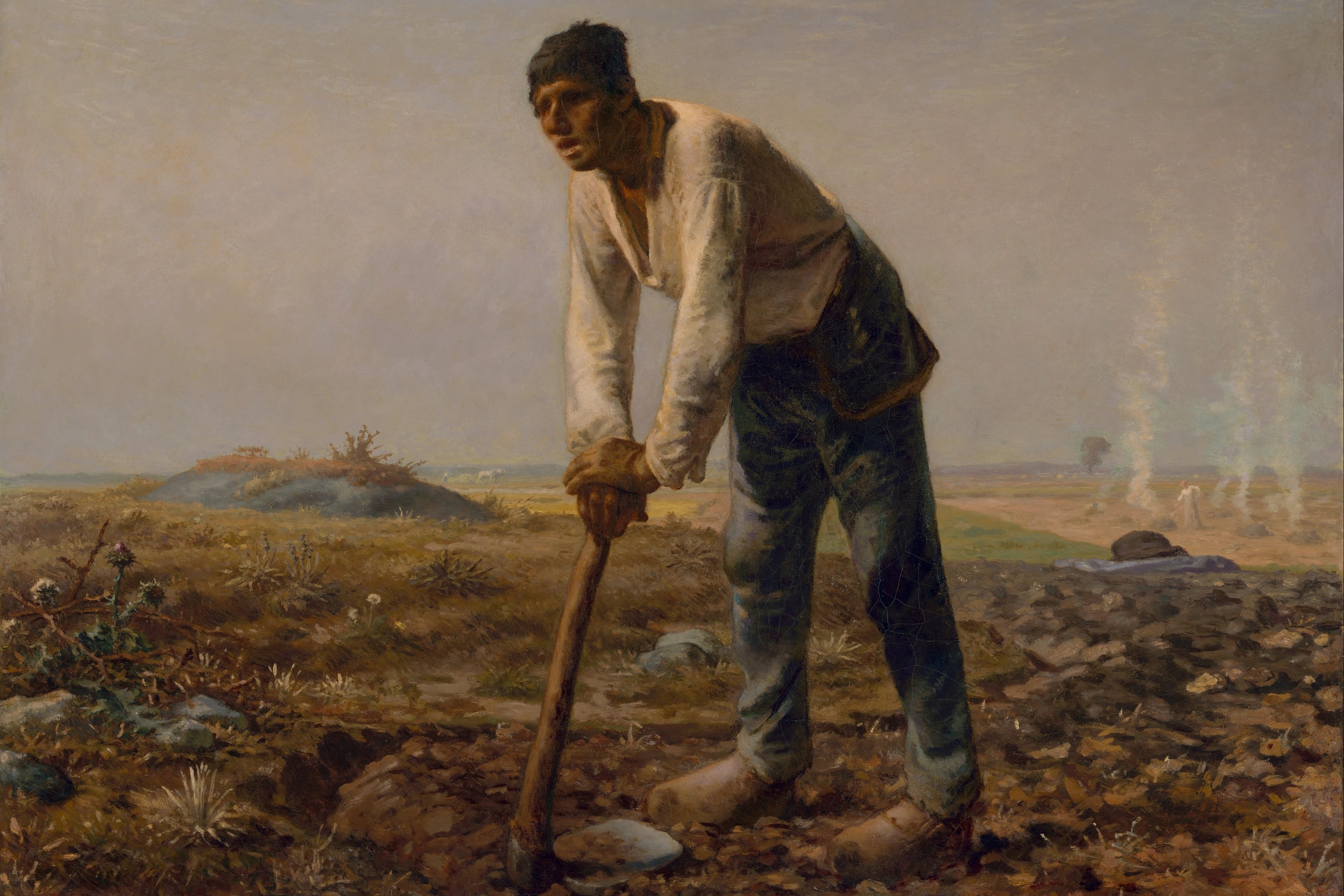
- Title image: Man with a Hoe by Jean-François Millet, Public Domain, Link